

October 2026
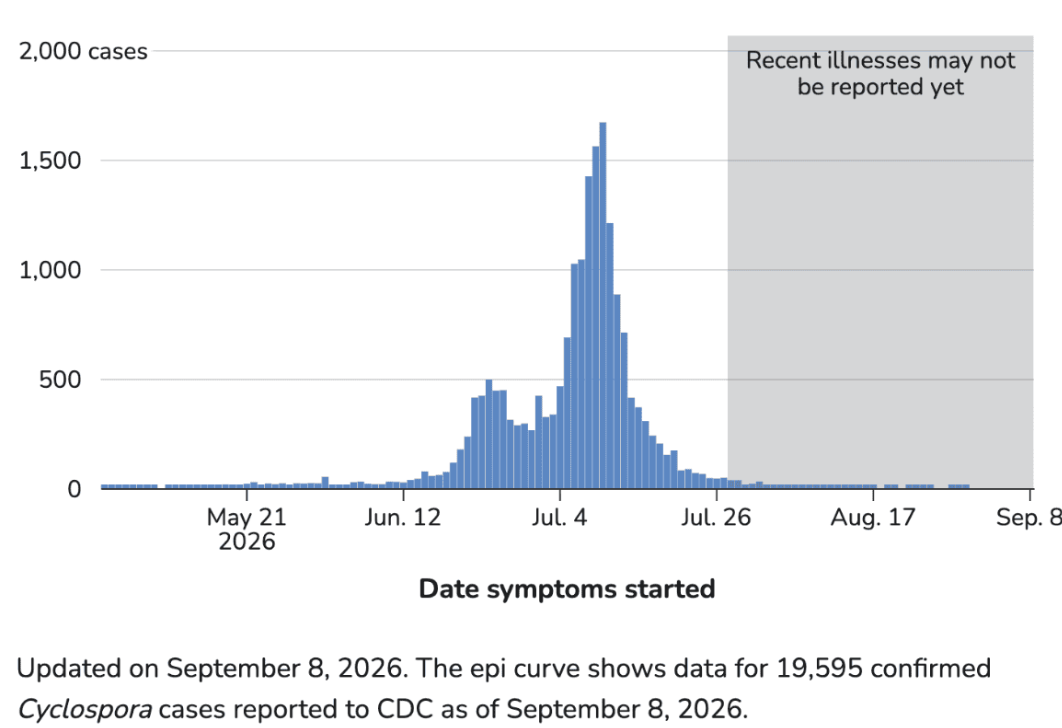
Cyclospora season is over, and it was a big one
Cyclospora season was declared over as of August 31st, 2026. The big wave of this diarrhea-producing bacteria ran from May 1 through August 31. The CDC has now confirmed 19,883 domestic cases, compared to just 1,180 during the same window last year. Georgia landed in the 50-199 case range overall. One cluster was traced to iceberg lettuce from central Mexico and prompted a Taylor Farms recall, but that outbreak has since ended, and no single source was ever identified for the rest. Case counts have dropped enough that the CDC stopped its weekly updates in mid-September, though stragglers will keep getting reported since it takes about six weeks from symptom onset to reach the CDC.
Dr. Neuman says: I didn’t go to Taco Bell beforehand, and this summer’s Cyclospora outbreak didn’t make me want to start.

First mRNA Flu Shot Gets FDA Approval
The FDA approved mFlusiva (mRNA-1010), Moderna's mRNA-based flu vaccine, for adults 50 and older. It's the first flu shot built on the same technology as the mRNA COVID vaccines. In a trial of over 40,000 adults, mFlusiva prevented 26.6% more cases of lab-confirmed flu illness than a standard-dose flu shot. Side effects were more common than with the comparison vaccine, though most were mild to moderate and lasted a day or two. Worth knowing that the approval came in two pieces: full approval for adults 50 to 64, and accelerated approval for adults 65 and older, meaning Moderna still owes the FDA a follow-up study in that group. It should be available at select retailers for the 2026-2027 season.
Dr. Neuman says: This study only compared the new vaccines with the regular-dose flu vaccine, not the higher dose we recommend for folks 65+. I will wait to comment on either until further studies are published. I recommend that most of my clients who are disabled, over 50 years old, have any lung disease or heart disease (including asthma, sleep apnea, and high blood pressure), and are smokers (and especially folks with all four) get any of the flu vaccines each year. See the next section for my vaccine recommendations for this season.

Vaccine Reminders
Flu: I recommend one dose yearly for all my clients. Early to mid-October is the sweet spot, since flu usually picks up in November, and antibodies (aka protection) take 10-14 days to form. Adults 65 and older should ask for a high-dose or adjuvanted version, which works better in that age group.
COVID: I recommend one dose yearly for adults 19 to 64. Adults 65 and older, and those at higher risk of complications (asthma, lung disease, heart disease, sleep apnea, smokers) get a second dose six months after the first. If you are unsure if you are at higher risk, reach out to me.
RSV: I recommend a one-time dose for adults 75 and older, and for adults 50 to 74 with conditions like heart disease, lung disease, diabetes, kidney disease, or a weakened immune system. Best given August through October.
Shingles: Two doses of Shingrix 2 to 6 months apart, starting at age 50, or anyone younger than 50 who has had it. One time series. Folks who had the old Zostavax should get the updated Shingrix. Does not matter whether folks have had chickenpox or not.
Pneumonia: Starts at age 50 for everyone, or earlier if you smoke or have diabetes, asthma, heart disease, liver disease, or kidney disease.
Tdap: A booster every 10 years, and one dose during every pregnancy between weeks 27 and 36.
HPV: Routine through age 26. For adults 27 to 45 who may have new sexual partners in the future, it's worth a conversation.
Hepatitis B: Based on risk factors (folks who bottom, take IV drugs, or have sex with folks who do) or simply if you want it—one series of three doses at 0, 2, and 6 months.
Reference: AAFP
